Friday, March 25, 2011

Therapeutic Puppetry.....

Tonight in class we learned all about therapeutic puppetry. We began class with an instructional video on proper puppetry skills with the Kids on the Block puppets. These puppets are designed to teach kids about disabilities, medical conditions and social issues. I learned that being a puppet master isn't as easy as someone would think. It actually takes a log of practice and skills to learn all of the techniques.

After the video we did a class discussion and learned how different types of puppets can be incorporated with many different populations. One great example is how puppets can be a very effective tool used by a child life specialist. A child life specialist can use puppets as a part of medical play and allow children to interact, ask questions, and "preform procedures" on the puppets. It was also interesting to consider that puppets can be used when working with individuals who have experienced sexual and physical abuse. The puppets may allow the individuals to open up and discuss things that they wouldn't feel comfortable talking about directly to someone else. Puppets can be a great tool to use when working with a variety of populations. Although many clients may benefit from the use of puppets, they aren't for everyone. Some clients may not like interacting with puppets and many therapeutic recreation specialist may not feel comfortable using them.

Friday, March 18, 2011

B.A.S.E. Jumping

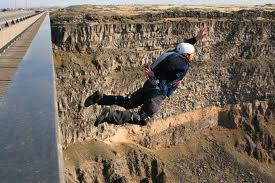
B.A.S.E. jumping is an extreme sport that involves jumping from fixed objects with a parachute. It is often compared to skydiving but it is considered to be much more dangerous. The acronym B.A.S.E. stands for the four different object that people often jump from, Buildings, Antennas, Span (bridges) and Earth.

Before BASE jumping became popular the jumpers used skydiving equipment. This included the main and reserve parachutes along with all of the deployment equipment. Today jumpers use more specialized equipment.

Although BASE jumping is not illegal many people are often fined for the activity. Many of the objects people jump from include buildings and antenna towers which are privately owned. A majority of the owners are reluctant to allow base jumping from their property so this sport is often done illegally. Jumpers who are caught can be charged with trespassing, breaking and entering, reckless endangerment, along with vandalism. If anyone is daring enough to try this dangerous sport it would be wise to get the proper authorization first.

Sandboarding......


Sandboarding is very similar to snowboarding, just take out the snow and add sand. It involves riding across or down a sand dune while standing with both feet strapped to a board. Some riders chose not to use a board with bindings but this is considered to be more dangerous. Once the rider has reached the bottom the ride to the top isn't always an easy task. Unlike snowboarding it is difficult to construct a ski lift to carry the riders back up. The riders either walk back up the sand dune after each run or ride a dune buggy or 4 wheel drive vehicle back to the top.

Equipment
A sandboards shape resembles a snowboard except a sandboards base is much harder than a snowboard. The boards are often made from wood, plastic, or fiber glass. To make it easier to ride the sand the bottoms of the boards are often waxed.

Fishing Float Tube


This is a great way to mix up the typical fishing trip. This tube allows individuals to fish while floating in the water. The bottom of the "seat" part clips in nicely. The bottom has a belt that clips in between the legs and then another around the waist. The seat is upright so it doesn't cause back pain. There is also a metal bar that goes along the front of it which allows individuals to feel secure. There are various loops where where paddles or various fishing items can be attached.

Tuesday, March 8, 2011

Zorbing.......


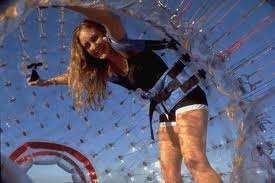
This is a form of recreation that involves rolling down a hill in an orb. I bet you are wondering what and orb is. Well it is two balls made of transparent plastic. A smaller ball is placed inside a larger one with a gap of air in between the two. The layer of air acts as a shock absorber. Inside the ball there is usually a harness attached to allow the rider to stay securely fastened down when rolling down the hill.
However, not all orbs roll down hills. Many times people are not in an area with hills so they have to be innovative. When there isn't a hill around riders often construct inflatable, wooden, or metal ramps.

Lived Experiences.........

Today in class we watched two videos that covered stories of several individuals who have some sort of disability. The individuals had a range of different disabilities but they all found a way to include a recreational sport into their life. Many of the individuals were diagnosed with their disability later on in life and had to adjust to the new life changes. I thought it was interesting to learn and hear how many of them were able to cope with their disability through therapeutic recreation. One lady described the result of becoming involved in sports while in her wheelchair as the time, "when the world opened" This shows that recreation can play such a huge role in a persons life. It was also inspiring that many of the individuals became more active after they were diagnosed with their disability. It's great to see them making the most of their life and not letting anything get in the way of their dreams.

Thursday, March 3, 2011

Adaptive Skydiving......

Many people are familiar with skydiving. However, not a lot of people are brave enough to jump from a helicopter/airplane while flying 3,000-13,000 ft in the air. Thousands of people a year do take the extreme jump, including quadriplegics and paraplegics. It is becoming increasingly more common to see someone who has a disability participate in skydiving.

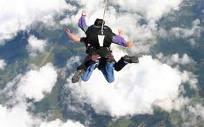
In order to participate in the jump there are only a few adaptations that need to be addressed. After the proper safety classes are given the guide and passenger then put on the proper safety gear. An additional step to ensure safety for a quadriplegic or a paraplegic is to duct tape their knees and ankles to the guides. This will prevent their legs from flying up and hitting the guide while on the descent. Once all geared up and ready to go it is time to board the helicopter/airplane. This step also requires some additional planning. In most cases the passenger will be unable to climb into the airplane/helicopter by themselves. No worries there though.....With a few people to help lift the passenger up and into the plane they are ready to start their journey. Once at the altitude they are going to jump the guide and passenger make their way to the edge of the plane and take the leap!

It is so great to see that adaptations are being made to allow people who have disabilities to skydive. It is such a rush and there is no other experience comparable to it. This is another activity I would highly suggest trying!